

Crocus sativus L. (saffron) belongs to Iridaceae family which is commonly cultivated in Asia, Europe and America. The commercial product and use of saffron comes from the dried stigmas which gives a yellow color, bitter taste and intense aroma. This spice has been used since ancient times because of its aromatic, flavor and coloring properties along with its functional characteristics. Saffron is applied in many food products as well as being utilized in medical treatments.
Azafran en la historia
El Azafrán (Crocus sativus L.) es una planta de la familia de las iridáceas que se ha venido cultivando, durante al menos los últimos 3.500 años, en la cuenca del Mediterráneo (España, Francia, Italia, Grecia, Turquía, Israel, Egipto), Suiza, Oriente Medio (Emiratos Arabes Unidos, Irak, Afganistán), Lejano Oriente (China y Japón) y últimamente Australia. Aunque en Turquía hay una provincia llamada Safranbolu, conocida por el cultivo de esta planta, en la actualidad el principal país productor de Azafrán es Irán (90%), a mucha distancia de España y después Marruecos.
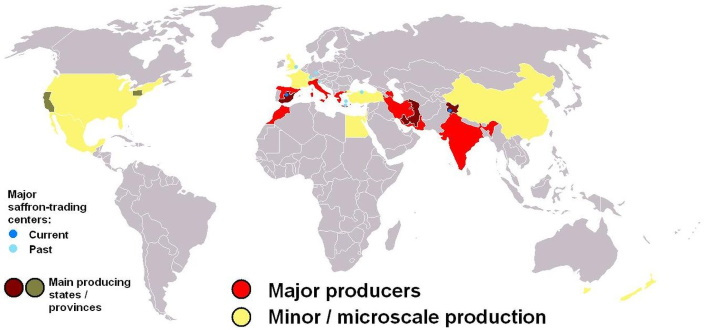 Países cultivadores de Azafrán. Imagen Myself.
Lately, scholars have focused on using herbal medicine for the healing of various diseases such as, tumor and heart-related disorders, along with functions such as antitussive, antioxidant, anti-inflammatory and antinociceptive, antidepressing, memory enhancing and treatment of Alzheimer's disease. The main purpose of this review is to highlight the recent advances of experimental in vitro and in vivo investigations focused on the stigmas and tepals of saffron, chemical composition, and application of its principal ingredients (crocin, picrocrocin and saffranal) in treatment of different diseases.
Key findings and conclusions
Despite the main usage of saffron is for culinary purposes, it also has significant applications in pharmaceutical and clinical fields. Saffron contains a number of bioactive components which are believed to be largely responsible for its health promoting properties including treating various disorders like asthma, atherosclerosis, painful menstrual periods and even depression; its role as an antioxidant with anti-cancerous and memory enhancing properties; its effectiveness at treating mild to moderate depression; and its high efficiency in lowering the levels of cholesterol and triglycerides in the blood of people suffering from cardiovascular diseases. The clinical findings suggest that saffron is a safe and effective plant. In the last decade, saffron has been studied for its unique properties to be employed within medical fields to treat many diseases.
Más información
Cultivo del Azafrán en Marruecos. Diario de Sevilla, 10 de Noviembre de 2018.
